Entradas

Mostrando las entradas etiquetadas como Madrid

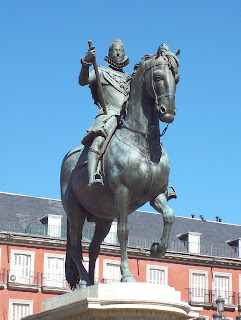
Statue of Felipe III
Imagen
The statue of Felipe III stands in the centre of Plaza Mayor. It shows King Felipe (Philip) III of Spain sat atop his horse in bronze; he has been remembered as "Philip the Pious" as a result of his strong religious beliefs. It was designed and sculpted by Jean Boulogne, an Italian artist, but completed by Pietro Tacca following Boulogne´s death. The statue originally stood in the Casa de Campo until 1848 when it was moved by Queen Isabella II to Plaza Mayor during her redesign of many of the city´s royal parks. During the Franco dictatorship, many statues and monuments to the Spanish royal family were destroyed, and it is an interesting story as to why this statue survived. The mouth of the horse was an open hole for a number of years prior to Franco, allowing a huge number of sparrow to fly into the horse and get trapped. Unable to get out, the birds starved to death inside the statue. This was unknown for years until an attempt, as decreed by Franco, to topple and demolish...

La Fuente de Cibeles

Imagen
La Fuente de Cibeles is a famous fountain and statue located in the centre of Madrid. Its location divides the districts Centro, Retiro and Salamanca. It is surrounded by many notable buildings, including Banco de España, Buenavista Palace and Linares Palace. The fountain sits at the intersection of three major roads in Madrid, the Paseo del Prado, the Paseo de Recoletos and Calle Alcalá. The statue was formerly located at the start of Paseo de Recoletos, but was moved to the Plaza de Cibeles in 1895, where it still stands today. It was built at the end of the 18th century under the orders of King Carlos III. He ordered a number of reforms and improvements to the ctiy at this time, including the introduction of pavements and gas street lightng, as well as artistic additions such as this fountain. It is an icon of the city, designed by the architect Ventura Rodrígues in 1777 and sculpted by Francisco Gutiérrez Arribas. It depicts Cibeles, the Greek goddess of nature and fertility, sat a...

The 3 most famous paintings in Madrid

Imagen
Madrid is rife with renowned and impressive art, housed in its prestigious institutions such as the Museo del Prado and the Museo de la Reina Sofia. In this post we are going to focus solely on three works of art, the most famous worldwide, which are currently housed in Madrid. These three paintings are Guernica  by Pablo Picasso, The Garden of Earthly Delights by Hieronymus Bosch, and Las Meninas by Diego Velázquez. At the end of the post you can also find a list of other important works which are worth seeing whilst in Madrid. Guernica , Pablo Picasso, 1937 "In the panel on which I am working, which I call Guernica, I clearly express my abhorrence of the military caste which has sunk Spain into an ocean of pain and death." Picasso Guernica by Pablo Picasso is one of the most famous examples of 20th century Spanish art. It is currently housed in the Museo Reina Sofia, after an initial showing in Paris, a subsequent international exhibition, and then temporary housing in the ...

Statue of the Falling Angel

Imagen
The Statue of the Fallen Angel, located in Buen Retiro Park for almost 140 years, and known in Spanish as "La Fuente del Ángel Caído", is commonly acknowledged as being the only public monument to the Devil himself in existence. Inspired by "Paradise Lost" by John Milton, this statue depicts the fall of the naked angel, the moment at which he is cast out of Heaven, and changes from Lucifer to Satan. He is depicted as a winged and naked young man, crying out in agony as the serpents entwined around his body drag him down to Hell. The statue, sculpted by Ricardo Bellver, was cast in bronze as a submission to the Third World´s Fair in Paris. After this, the piece was acquired by the Museo del Prado, and then later on was donated to the city of Madrid, leading to its inauguration at its current location in 1885. The sculpture is set atop a marble pillar in the centre of a fountain, which is decorated with other demonic characters and animals, and this is further surroun...

Outdoor Swimming in Madrid

Imagen
As we move further into June and Madrid starts to heat up, let´s have a look at some of the outdoor swimming that the city has to offer. The three main options that Madrileños pursue to cool off in the scorching months of June to August are: municipal outdoor pools in the city, natural pools (such as reservoirs and lakes) a bit further out, or private rooftop pools. It is also worth noting that the city´s sports centres have a variety of municipal indoor pools which are open year round whilst the outdoor pools open only for a few months, though an indoor pool may not be as promising a prospect on a 40 degree summer day. Municipal outdoor pools The city of Madrid currently has 20 different official public pools, "piscinas de verano", under the wing of Centro Deportivo Municipal (CDM), located throughout various neighbourhoods of the city. They usually open in early May, remaining open until about mid-September. They are definitely the most economical means of swimming in Madri...

Las escapadas de Madrid

Imagen
Toledo Toledo es una ciudad a menos de una hora de Madrid en tren o en autobús. Conocida como la "ciudad de las tres culturas", Toledo tiene una historia rica en tres religiones diferentes. Durante muchos años, había un ambiente de tolerancia multicultural y los musulmanes, los judíos y los cristianos vivieron juntos. Hay mucho arte, edificios hermosos, callejuelas pequeñitas y buenísima comida. El dulce típico de la ciudad es el mazapán, pero otro producto que debes probar es el queso manchego. Los monumentos más importantes de Toledo son la Santa Iglesia Catedral, una iglesia de estilo gótico considerado por algunos como la mejor de este estilo en España, el Alcázar, una fortificación militar en la parte más alta de la ciudad. Puedes contemplar desde el Alcázar una panorámica preciosa de toda la ciudad. También hay que destacar la Iglesia de Santo Tomé donde se encuentra el cuadro más importante de El Greco "El entierro del Conde Orgaz". No podemos olvidar el Mona...

Aprende cómo hacer Sangría

Imagen
Sangría, la bebida del verano Seguramente habéis visto sangría embotellada en una tienda o en un supermercado. Y si os gusta la sangría, ¿por qué no prepararla en casa? Esta bebida es popular y refrescante, y puede servirse con casi cualquier plato, para almorzar o para cenar.  Sus ingredientes básicos son: vino tinto y   frutas. Pero si queréis, también podéis añadir una alcohólica dulce, por ejemplo vodka, brandy o ron. El vino que se utiliza es un vino tinto. Puede ser Rioja pero también se utiliza cualquier vino tinto de menor calidad. A pesar de sus orígenes humildes, es ahora una bebida conocida en todo el mundo. En Madrid, la receta de sangría es diferente en todos los restaurantes, al igual que la graduación alcohólica. Algunos restaurantes tienen una receta deliciosa y de gran calidad, pero otros restaurantes saben que la sangría es una bebida solicitada por los turistas y se aprovechan poniendo vino de baja calidad. El nombre viene de la palabra "sangre" por el colo...

Fiesta de San Isidro

Imagen
Fiesta de San Isidro y las ferias taurinas La Fiesta de San Isidro se celebra cada año el 15 de mayo en honor al patrón de Madrid, San Isidro Labrador. Se cree que San Isidro nació en el año 1080 en la calle de Las Aguas en el barrio de La Latina. La leyenda de San Isidro cuenta que cuando su hijo se cayó en un pozo, San Isidro rezó a Dios para que lloviera y llenara el pozo de agua. Esto ocurrió, y su hijo pudo salir del pozo. Lo más curioso es que salió totalmente seco. Desde entonces, los madrileños piden a San Isidro para que llueva. Los madrileños celebran San Isidro el 15 de mayo porque fue el día en él que su cuerpo fue trasladado a la Iglesia de San Andrés y finalmente fue depositado en el altar mayor de la Colegiata de San Isidro. La Colegiata de San Isidro está cerca de la Pradera de San Isidro, el sitio en el que se celebran muchas actividades el 15 de mayo y los madrileños acostumbran a comer en la Pradera la típica tortilla de patatas, además de otros ejemplos de la cocina...

La Cuesta de Moyano

Imagen
La Cuesta de Moyano, una feria permanente de libros madrileña La Cuesta de Moyano es una calle famosa para la venta de libros. Se fundó en 1919 y llevó el nombre de Claudio Moyano, un político español del siglo XIX. Es parecida a la de los "buquinistas" de la orilla del Sena en París. La vía conecta el Paseo del Prado con el Parque de Buen Retiro, y se convirtió en calle peatonal en 2007, incluido un carril bici, para convertirse en un lugar agradable para pasear. Hay 30 casetas dedicadas a la venta de libros nuevos y de segunda mano, y ahora en los tiempos del COVID, más o menos solo 4 están cerradas. Desde hace casi un siglo, las casetas han estado abiertas, sobreviviendo a todos los avatares de la capital: una república, una guerra civil, una dictadura, el malestar social, una democracia y, ahora, una pandemia. Las casetas están dirigidas por los hijos y los nietos de los fundadores de la feria. Hay dos monumentos en los dos lados de la feria. Una estatua es de Pío Baroja,...

What Spanish language exam should I take?

Imagen
Why should I take a Spanish language examination? Taking a Spanish language examination can provide you with viable proof of your profiency in the language, allowing you to then list this as an asset on your CV or any applications. Many opportunities, including studying in Spain, require a minimum proficiency for entrance. Furthermore, even if you are studying Spanish recreationally, studying for and passing a proficiency exam can provide you with motivation to achieve a clear goal, and is a good way of measuring your progress. There are a few different types of certifications to consider, and it is important to choose the right one for you. What are the different certifications I should consider? The three main certifications to consider are: the DELE , the SIELE and the CELU . DELE stands for Diplomas de Español como Lengua Extranjera. The DELE certifications come in different levels, ranging from A1 to C2. An applicant selects a specific level of exam that they wish to achieve. This...

Understanding the Madrid 4th of May Elections

Imagen
As a tourist or expat in Spain, it is an interesting experience to watch an election pass through the city you are visiting. The surrounding events manage to be both close to you, and yet far in direct impact. The atmosphere in the city, however, is distinctly palpable. From campaigners in the Puerta del Sol, to posters lining the Paseo del Prado, one can´t help but feel invested. This article will break down  the election to its basics, to give extranjeros a chance to understand what´s going on! The elections happening on the 4th of May are a Madrilenian regional election. The people of the Community of Madrid will vote to elect the 12th Assembly, with all 136 seats in the assembly up for grabs. A bit of background: The current political system in Spain is a parliamentary monarchy, whereby the ruling monarch is the official head of state, whilst the prime minister serves as head of the government. The current ruling monarch is Felipe VI and the current prime minister is Pedro Sanc...

Studying Spanish in Madrid during COVID

Imagen
For many language learners out there, living and studying in a city that speaks the language is an invaluable experience. The opportunity to immerse yourself in the culture and be constantly surrounded by the language hugely exacerbates the learning process. When I decided that I wanted to learn Spanish, and to do so in a short space of time, I was certain that finding an opportunity to move to Madrid for a few months would be the best idea. In the current moment, with all the complications that COVID brings to international travel, I was uncertain if I would even be able to get out of London. I had already spent months in lockdown trying to familiarise myself with the basics of Spanish grammar, learning through textbooks and websites. At this point, I started researching language schools and opportunities to take Spanish classes in Madrid, and I found Eureka. Offering  immersive language classes , along with accomodation nearby and internship placements, this seemed like the answe...

¡Un saludo a vosotros y a Madrid! :D

Me quedan pocos días antes de que me vuelva a Italia y empiezo a pensar qué me llevo de Madrid y demi experiencia aparte  de  una maleta llena de ropa que seguro no cabrá.  Antes de todo el recuerdo de una ciudad maravillosa que te da muchas oportunidades, no me refiero al trabajo sino de salir, de ir al gimnasio porque hay un montón de disciplinas deportivas nuevas, de tiendas y mucho más. Me llevaré el recuerdo de calles muy grandes y llenas de gente hasta no se qué hora, de bares llenísimos a los que no te puedes acercar, de edificios muy grandes y decorados que por la noche juegan con los colores amarillo, verde y rojo de los balcones, de los espectáculos de magia o de baile que encuentras cada día en la  Puerta del Sol, de los chicos que te paran todos los día para pedir firmas para ayudar a los más pobres y nunca se acuerdan que te han parado ya el día precedente, el recuerdo de que la mayoría de los españoles tienes perros pequeños y simpáticos porque ...

El Ratoncito Pérez

Imagen
¿Quién cuando era pequeño no ponía el diente de leche debajo de la almohada esperando a cambio una moneda o  un regalito? Según los países para algunos viene el Ratoncito Pérez, para otros  el hada de los dientes. El origen más probable del ratoncito y su enlace con un hada proviene de un   cuento   francés del siglo XVIII de la baronesa   d’ Aulnoy :   La Bonne Petite Souris  (El Buen Ratoncito). Habla de un   hada  que se transforma en un ratón para ayudar a derrotar a un malvado rey, ocultándose bajo la almohada del mismo, tras lo cual se le caen todos los dientes. En   España su historia  se debe al jesuita   Luis Coloma   (autor de   Pequeñeces, Jeromín  y otras piezas)   que escribió un cuento cuando a Alfonso XIII  que entonces tenía 8 años, se le cayó un diente.  Coloma   lo presenta como un bonachón personaje que muestra al Rey Buby (apodo con que la Reina María Cristi...

Semana Santa en Madrid

Imagen
http://www.elconfidencial.com/sociedad/viajes/2015-03-27/semana-santa-madrid-planes-bares-museos-procesiones_735011/ La Semana Santa en España se celebra desde el  29 de Marzo hasta el 5 de Abril. A pesar de que ciertos días son comunes en el calendario festivo, cada región mantiene la tradición de sus celebraciones a través de misas y procesiones multitudinarias. Los cristianos   conmemoran durante la Semana Santa la entrada de Jesús a Jerusalén, cuando todo el pueblo lo alabó como rey con palmas (Domingo de Ramos), la última cena de Cristo (Jueves Santo) en la que, según el Nuevo Testamento, Cristo ofreció   pan y vino   a sus apóstoles, dando origen a la Eucaristía o Comunión. También se conmemora la muerte de Cristo en la cruz (Viernes Santo), su día de reposo en el Sepulcro (Sábado Santo o Sábado de Gloria) y, finalmente, su posterior Resurrección (Domingo de Resurrección o Pascua de Resurrección). En España, aunque hay diferencias de una región a o...